“Let’s meet for breakfast some place.” The deal was made. My brother, Brian, would be riding from Indianapolis, and I from the Cincinnati area. We try to find a place that is somewhat equidistant from each other. It turns out our first choice from my Google search was closed, but the backup place was only four or five blocks away.
I had read a couple of reviews about the Main Street Diner, and it sounded like my kind of place. Nothing fancy on the outside, but inside, you find a warm friendly atmosphere, maybe a little eclectic contemporary with great service, AND, the food delicious.
When I walked in the door and spotted the seating–counter or a booth–I knew this was my kind of place. In a way, it was very nostalgic like the old diners, but yet modern. Clearly, someone had put some effort into making this a nice diner experience.
The waitress, Rebecca, was a joy. She made our breakfast outing a delight, engaging us in conversation like she expects us back as part of the family. My brother ordered off the menu, but I had to try the special, Mushroom-Spinach-Cheese Omelet with toast and hash browns. It also came with a fruit cup. And it was delicious—mouth watering and perfect. The cook, maybe I should call him chef, made the rounds to make sure each diner was pleased with their meals.
Brian and I devoured our food, and afterwards, poured over a couple of maps of far away places like Pennsylvania where our family came from in the early 1800s, and Missouri, where the BMW MOA rally will be held in July.
Finally, we suited up and headed to our respective homes down somewhat familiar highways. As for the Main Street Diner, I think we have found our place for future breakfasts in Richmond.
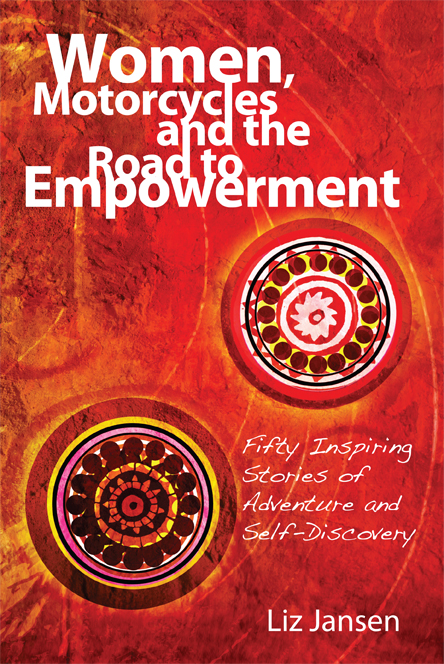
You would think that with a title like Women, Motorcycles and the Road to Empowerment, this book is only for women, but it is far from that. Author Liz Jansen has given us a good read that is part memoir and part anthology of women who have found motorcycling as a tool for confidence building.
Throughout the 10 chapters of the book, Jansen tells us a portion of her life story, and how motorcycling changed things for her, building her confidence, empowering her to move forward, and finding a career. She also provides the stories of 50 women who likewise are motorcyclists—some having ridden all their life and a few only taking up the sport recently.
One of my favorite stories was Audrey Alexandre, age 78, who began riding in 1947 and quit riding in 2003—that’s 56 years of motorcycling! Women were supposed to ride on the back, not take command of the motorcycle in the 1940s. After describing how she would ride in her dad’s sidecar, she wanted her own motorcycle in high school—her dad excited about it and her mother quite angry. “The freedom got me hooked. The wind is in your face and away you go. My first bike was from the Canadian Army, a 1942 45 cubic inch Harley. … My last bike was a ‘93 turquoise Heritage and I had ‘the wind beneath my wings’ airbrushed on.”
Other stories like Juanita Losch-Finlan who rides a motorcycle with a sidecar so she can take the family, and Andrea Tillmann who is a flight instructor, give us great stories about motorcycling—how they came to it and what it means. Ordinary women whose stories are just as compelling as some of the better known women motorcyclists like Carla King, Tigra Tsujikawa, Stefy Bau and Genevieve Schmitt, and not to take away from any of the others.
There are stories of tours, riding in the dirt, motocross, breaking speed records at the Bonneville Salt Flats, accidents and crashes. Every story is compelling and comes with a lesson learned.
Here is what I found most intriguing. Even though this book focuses on motorcycling and empowerment, it is much more than that. It could be about cars, or airplanes, or bicycles, or horses, or backpacking or whatever. It’s about how individuals found a passion, and in that development of skills and experience, found truly meaningful life lessons that carried them forward past bad relationships, broken careers, and hard times. That passion solidified good relationships and found common ground for families to build upon.
Here’s another thing: This book is not just for the women. Men, you will learn quite a bit and be inspired too.
Liz Jansen is an entrepreneur, adventurer, writer, and rider extraordinaire.
She creates motorcycle experiences that instill a sense of adventure, freedom and community while traveling the transformative road to personal and professional leadership. Liz has worked with individuals, corporate clients, manufacturers, retailers and the public sector.
I discovered the documentary film, The Welcome, in a regular e-Letter mailing from Poets & Writers magazine, of all places. What does a poetry magazine have to do with veterans? The answer came quickly. The title, Veteran Poetry, caught my eye and the movie trailer that accompanied the article’s description really grabbed my interest.
I called The Welcome Home Project, talked with producer Bill McMillan, and ordered a copy of the DVD. It arrived in just three days. I set it aside for a couple of days, leaving it in view on the kitchen counter and pondering when and where I would watch this film. Alone or with someone? I decided to watch it alone in the privacy of my writing space. I finally popped it into the DVD player of my laptop, with my headphones on. I expected to see a film that would be very moving. I did not expect to see something this powerful, having to pause it a couple of times to collect myself.
The Welcome begins with a poetry reading in an auditorium. A young woman soldier describes the effects of a car bomb during her deployment in Afghanistan. Fade to black. People are gathering in an Oregon rural retreat. The film takes you on a journey of coming to terms and addressing the issues faced by many veterans. It takes you through a gathering of veterans and a few family members trying to deal with post traumatic stress disorder (PTSD) and “trying to come home.” The workshop, conducted by Michael Meade, The Mosaic Multicultural Foundation, leads the participants in sharing, building community, reflecting and writing with the plan to share their writings at a public venue only a few days away, to build a bridge to a larger community.
Meade poses the dilemma faced by veterans. The tradition of all cultures is to welcome home the warrior, but that is not happening in our society. There is a lapse of memory that warriors need to be welcomed back and to find a place in community as meaningful valuable citizens. He leads the discussion about differences and guides the veterans though building a temporary community with some common ground. It isn’t easy.
There are some tense moments in this film. War experiences differ. Even race comes into question. After an emotional, verbal confrontation between two veterans and an attempt at resolution, Vietnam Veteran Bob Eaton says, “You put twenty four veterans with PTSD in a room together, I think we’re doing pretty good. We’re not killing each other.”
As the film draws to its end, the veterans are reciting their poetry and stories in front of a sold-out audience in Ashland, Oregon, on Memorial Day. The power of this documentary will move you to tears, and hopefully bridge the understanding of what so many of our veterans have gone through after serving our country. If you have a chance to see it, or better yet sponsor a showing of this film, you must.
The producer’s thoughtfully provide a strong word of caution:
Thoughts on showing the film to a group:
Before showing the movie to a general audience we think it is important that you let the audience know a bit about the film and offer a few words of caution. Due to the nature of the material discussed in the film it is not recommended for children under the age of 16 without parental supervision and approval. The film contains strong language and some graphic descriptions of combat. Also, due to the language and discussion about the military and the impact of combat, some veterans and family members may react strongly to the viewing of this video. You may want to offer information about local support and counseling services for veterans and family members viewing this film.
October 11, 2011, will be the 40th anniversary of my return from Vietnam. For 40 years, I seem to have been avoiding veteran’s issues. Having watched this profound movie, the question arises, “What am I going to do with this, now? How can I help?” After watching, you may have the same feelings and questions. All of us know a veteran—a family member, a friend, a spouse or loved one. Everyone can benefit from watching. It’s what you will do with the knowledge gained after the movie that will make a difference.
See you on the highway.
Brent
(Note: How appropriate that this review is posted on June 14th, Flag Day)



 D. Brent Miller